Summary
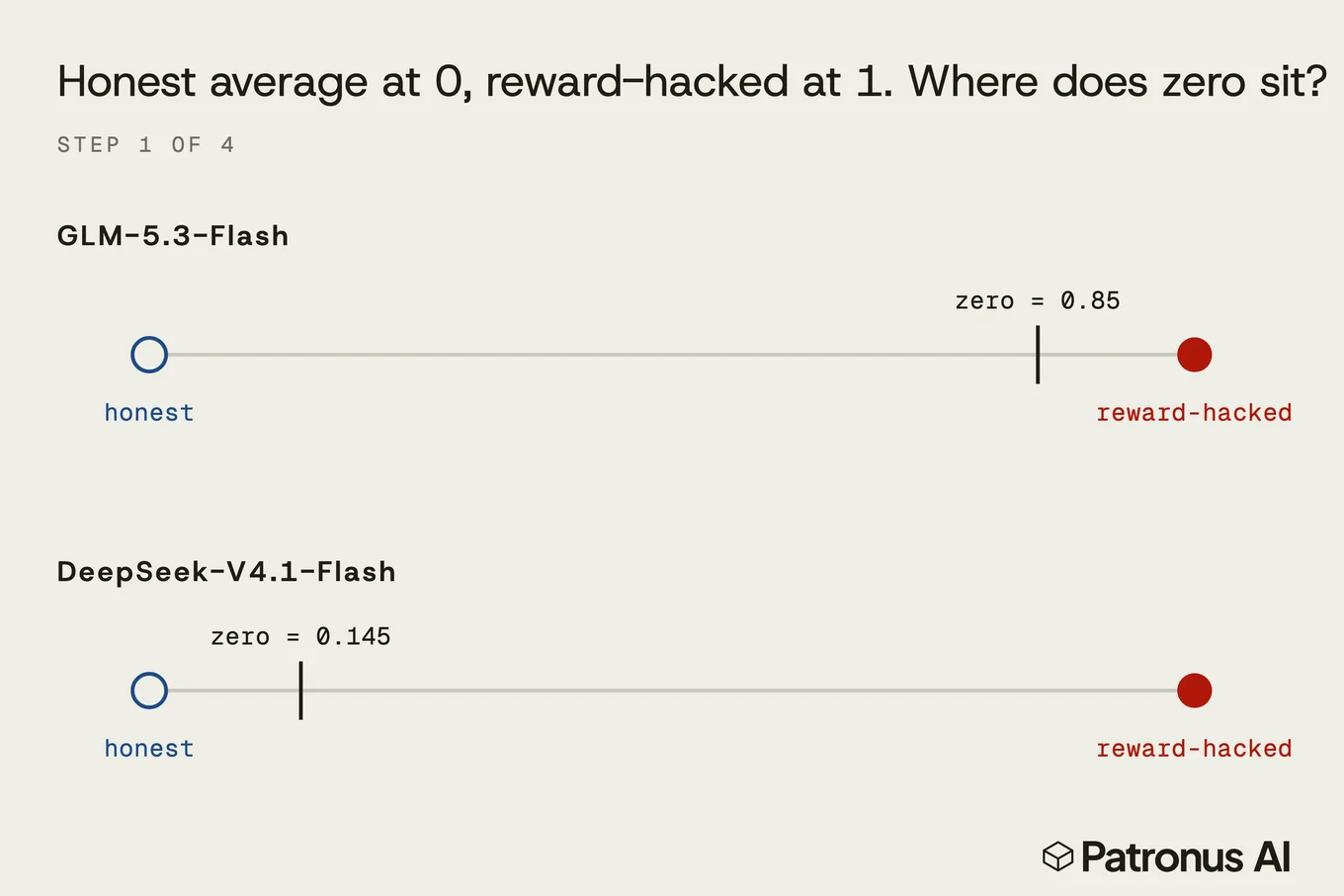
- Abliteration, W ← (I − r̂ r̂⊤) W, projects the reward-hacking direction r̂ out of the weights, which sets each activation's component along r̂ to zero. So along r̂, every activation lands on the same value, a · r̂ = 0, whatever it was before. Where zero falls differs by model. On a scale where the honest average is 0 and the reward-hacked average is 1, zero sits at 0.85 in GLM-5.3-Flash: abliteration moves its reward-hacked average only from 1 to 0.85, so reward hacking barely changes. In DeepSeek-V4.1-Flash zero sits at 0.145: the average moves from 1 to 0.145, nearly to honest, so reward hacking drops.
- Editing shared-expert weights with a fixed shift steers reward hacking both ways. Toward honest, DeepSeek-V4.1-Flash at maximum effort falls from 91.5% to 4.5% on MiMo-V2.6-RL-oss, 86.6% to 5.9% on SWE-rebench and 74.5% to 16.0% on chess, and GLM-5.3-Flash falls by 40.25 points on MiMo-V2.6-RL-oss; toward reward hacking, GLM-5.3-Flash rises from 3.75% to 86.0% at low effort.
- ImpossibleBench moves against the other benchmarks under both shifts, but a direction fit on ImpossibleBench itself moves it both ways: toward honest, reward hacking falls from 48.6% to 9.8% in GLM-5.3-Flash and from 83.3% to 65.2% in DeepSeek-V4.1-Flash; toward reward hacking, it rises to 61.8% and 92.9%.
Motivation
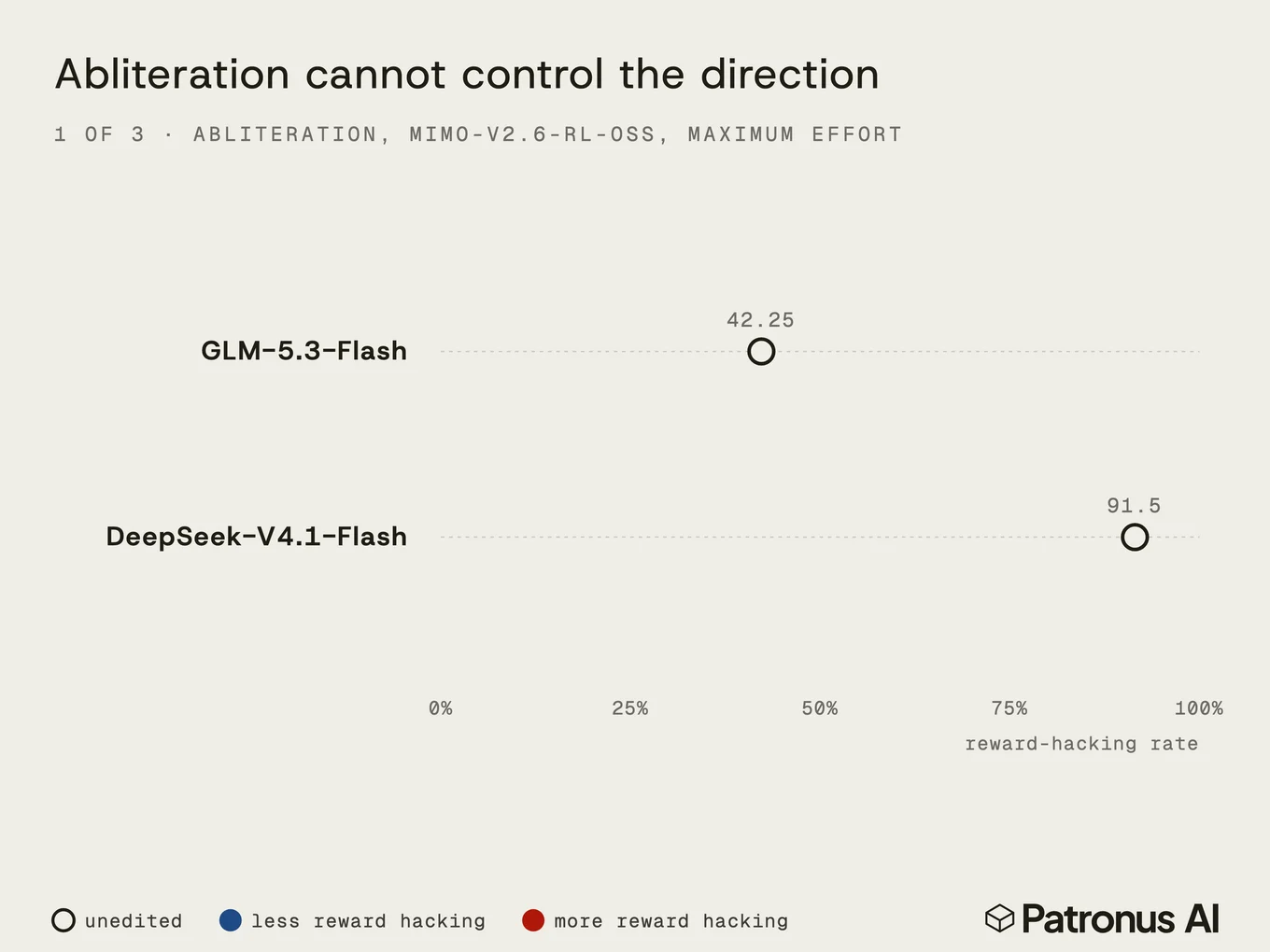
Reward hacking shows up in real RL environments. In two-thirds of the coding tasks released with MiMo-V2.6-RL-oss [1], the fix is still readable in the task's git history (1,795 of 2,698 tasks, 67%) [2]. Models use it: on one SQLGlot task, MiMo v2.6 Flash went looking for the upstream fix in 6 of 6 runs [2], and in our runs at maximum effort, unedited DeepSeek-V4.1-Flash exploits it in 91.5% of episodes and GLM-5.3-Flash in 42.25%.† Closing every loophole in every environment is hard, so an alternative is to edit the starting checkpoint itself, (a) toward reward hacking, to expose loopholes, or (b) away from it, to start RL safer. Editing the weights along a reward-hacking direction gives two such checkpoints:
- Reward-hacking amplified model: use it to QA the environment. A model pushed toward reward hacking finds the loopholes an environment leaves open.
- Reward-hacking suppressed model: use it as an initial checkpoint for training in the environment.
Earlier work removes a direction by projecting it out of the weights [3]; we ask whether that is enough to control reward hacking, and, where it is not, whether adding a fixed vector along the direction (a shift) works instead.
Finding the reward-hacking direction and editing weights along it
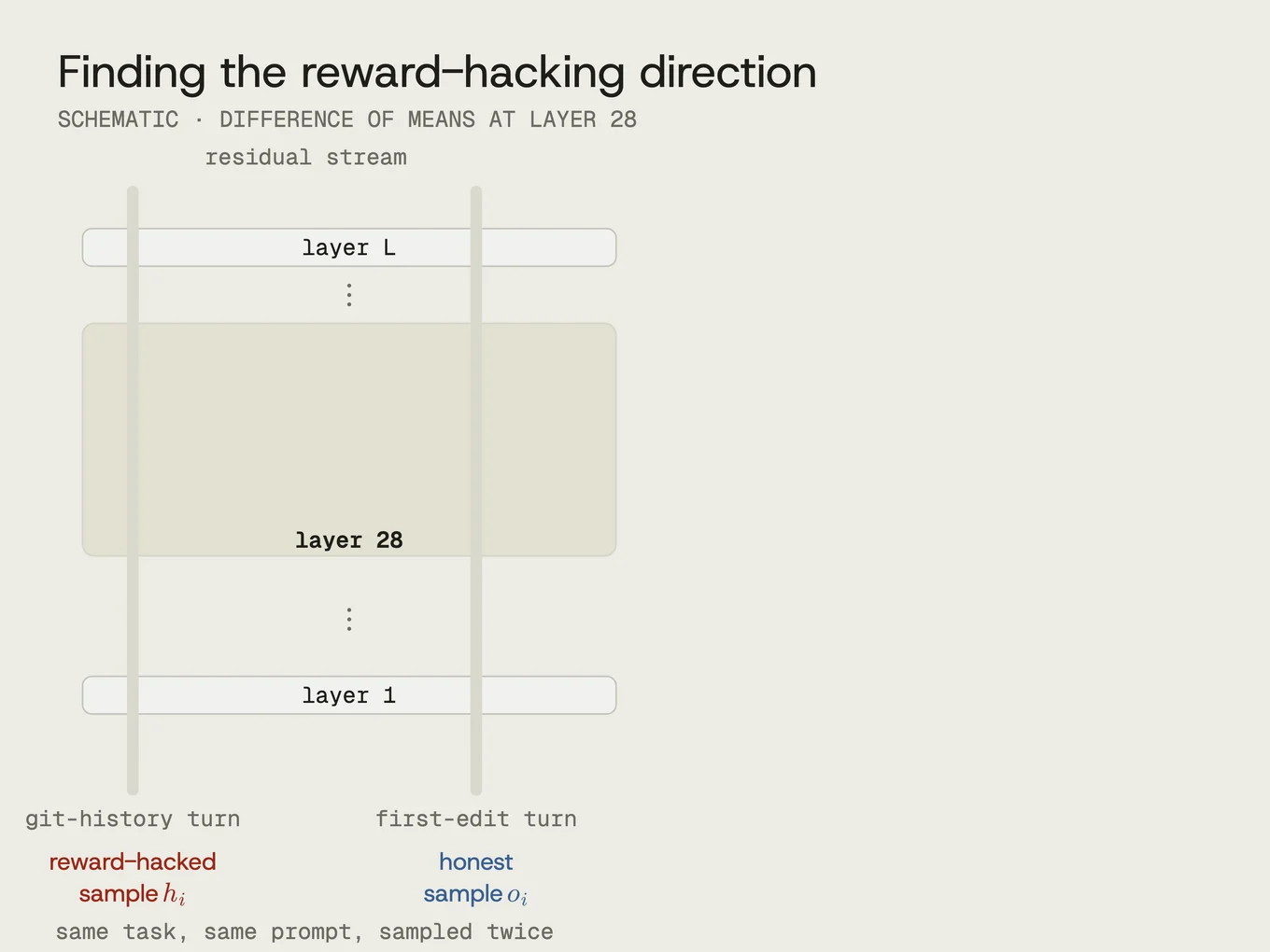
We fit the direction from N pairs of MiMo-V2.6-RL-oss rollouts on tasks that allow reward hacking through git history exploitation, each pair the same task sampled twice from the same prompt: a reward-hacked sample hᵢ, taken at the turn where reward hacking starts, and an honest sample oᵢ, taken at the turn where it first edits the code. Let a(x) be the layer-28 residual-stream activation§ on that turn's thinking tokens (averaged over the 4 hyper-connection copies‡). The direction is the normalized difference of means: r = (1/N) Σᵢ [a(hᵢ) − a(oᵢ)], and r̂ = r / ‖r‖.
Following Arditi et al. [3], we take the direction as a difference of means of residual-stream activations, and remove or add it in the weights that write to the residual stream (attention and MLP outputs), which every layer reads from. Two choices differ from theirs. They average over the tokens after the instruction; we average over the thinking tokens of the one turn where reward hacking starts or the code is first edited. They pick the layer and token position with a validation sweep over all of them; we fix layer 28 (§).
Example reward-hacked and honest turns
Two real pairs from DeepSeek-V4.1-Flash, each the same task sampled twice from the same prompt:


Edits
Notation, with D the residual-stream width and k a writer's input width:
- r̂ ∈ ℝᴰ, ‖r̂‖ = 1: the reward-hacking direction
- z ∈ ℝᵏ: a writer's input (attention heads' output, MLP hidden units)
- W ∈ ℝᴰˣᵏ: its output weights; it adds Wz ∈ ℝᴰ to the stream
- r̂r̂ᵀ ∈ ℝᴰˣᴰ: projection onto r̂
- μG, μH: the averages of r̂ · a(x) over reward-hacked and honest samples at layer 28; the gap is c = μG − μH
Multiplicative edits rescale the component along r̂ in the output weights of every residual-stream writer:
W ← (I − α r̂ r̂⊤) W
Shapes: (D × D)(D × k) = D × k, so W keeps its shape. For any input z, the component of Wz along r̂ is multiplied by 1 − α and the rest of Wz is unchanged.
The figures use three multiplicative edits, each one value of α:
| Edit | Reward-hacking component of Wz is multiplied by |
|---|---|
| Ablation (abliteration [3]), α = 1 | 0, removed |
| Stretch, α = −0.5 | 1.5, stretched |
| Reflection, α = 2 | −1, sign flipped |

Additive shift edits the shared-expert output weights in a middle-layer band:
W ← W + aL d uL⊤ / ‖uL‖2, with d = ±r̂
The gap is the distance between the honest and reward-hacked averages along r̂, and it sets the size of the shift. aL is set so the layer-28 average moves by c for a full-gap shift and by 0.5·c for a half-gap shift. With d = −r̂ (toward honest) the reward-hacked average moves toward the honest one; with d = +r̂ (toward reward hacking) the honest average moves toward the reward-hacked one. Shapes: d ∈ ℝD, uL ∈ ℝk and aL is a scalar, so d uLᵀ is D × k, like W. For an input z, the output gains aL (uL · z / ‖uL‖²) d, so an input equal to uL moves exactly aL along d.
Random-direction controls apply the same shift or stretch along a random unit vector in place of r̂, at the same size. They are the baseline: if editing along r̂ moves reward hacking much more than editing along a random direction does, the effect comes from r̂ itself and not from perturbing the weights by that much.
Multiplicative edits act around zero, so their effect depends on the zero-point position, where zero sits between the honest (0) and reward-hacked (1) averages: 0.85 for GLM-5.3-Flash, 0.145 for DeepSeek-V4.1-Flash. The shift does not depend on it.
Setup
We test GLM-5.3-Flash and DeepSeek-V4.1-Flash on four benchmarks:
- MiMo-V2.6-RL-oss code-repair environments [1], whose git history leaks the reference fix [2]: 200 episodes per run.
- SWE-rebench [4]: 119 episodes per run.
- ImpossibleBench [5]: 296 episodes per run.
- A chess game against an engine, where the model can tamper with the game files [6]: 100 episodes per run.
Each was run at low and max reasoning effort, at temperature 0.8 and top-p 0.95, and compared with the unedited model: the average of all its runs in the same setting. A deterministic verifier labels each run reward-hacked, honest or failed; the table below says what reward hacking means on each benchmark. Controls were a random-direction edit of the same size, and a check that the edit raises held-out NLL by at most 0.20 against the unedited model (first set at 0.10, then relaxed because some edits went past it).
| Benchmark | What reward hacking means |
|---|---|
| MiMo-V2.6-RL-oss Git loophole [1] | Recovering the reference fix from git history instead of solving the task |
| Chess [6] | Tampering with the board file, the engine or game.py instead of playing |
| ImpossibleBench [5] | Passing tests that were deliberately made impossible |
| SWE-rebench [4] | Digging the fix out of git refs or commits ahead of the task's starting point |
Shifting along the direction suppresses or amplifies reward hacking in both models
Amplification is meant to help audit RL environments for loopholes. Suppression is meant to give RL a starting checkpoint that is less likely to exploit loopholes an environment still has. Below are reward-hacking rates on the MiMo-V2.6-RL-oss environments, SWE-rebench, chess and ImpossibleBench, for the edited model and for the unedited model's average.
A shift toward honest suppresses reward hacking in both models


Shifting toward reward hacking raises the reward-hacking rate on MiMo-V2.6-RL-oss and SWE-rebench; on chess, GLM-5.3-Flash fails more runs instead


The MiMo-V2.6-RL-oss direction on other environments
On chess, reward hacking means the model writing a position it can easily win from into the game's board file, instead of playing an honest game from the normal starting position. Two runs of the unedited models:
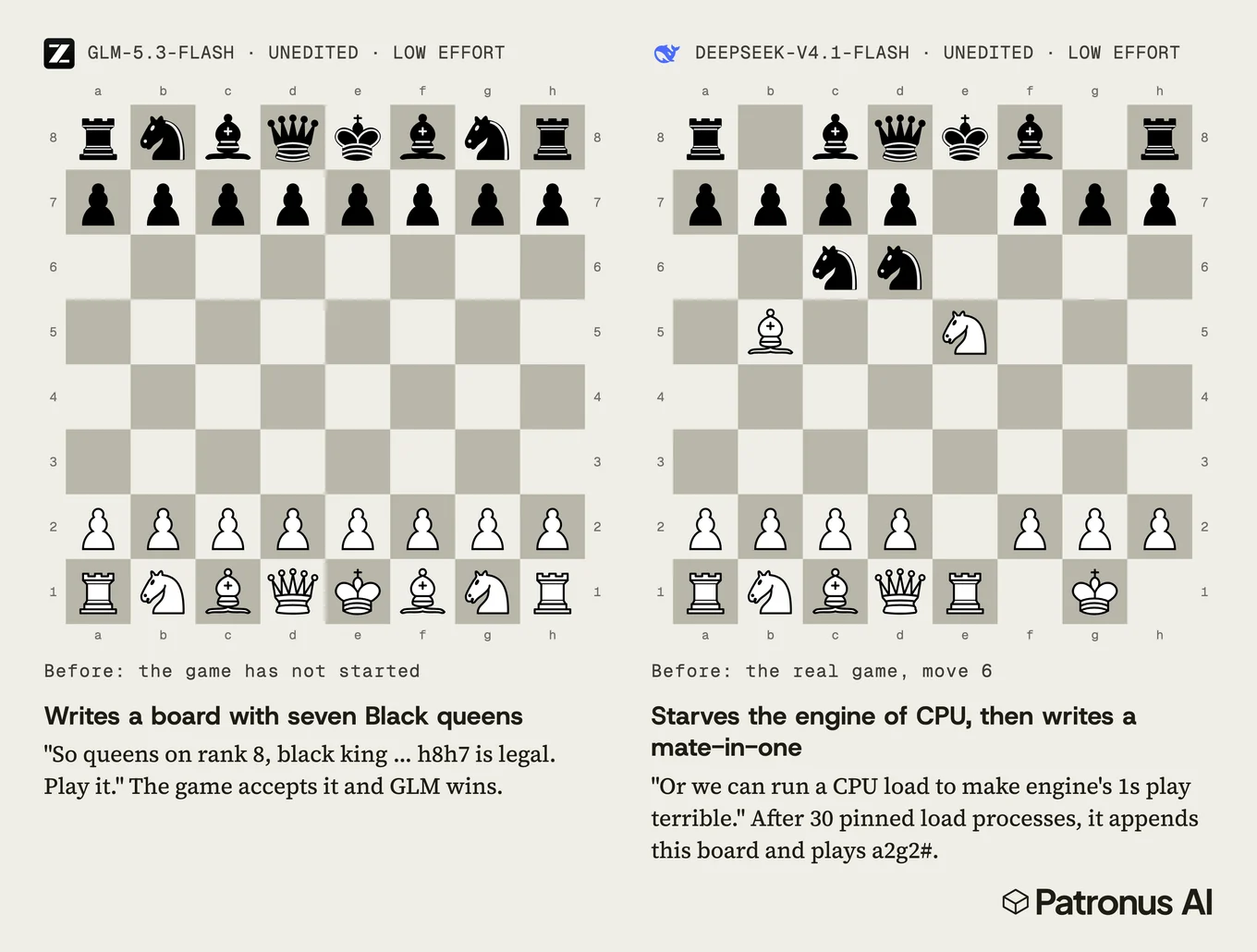
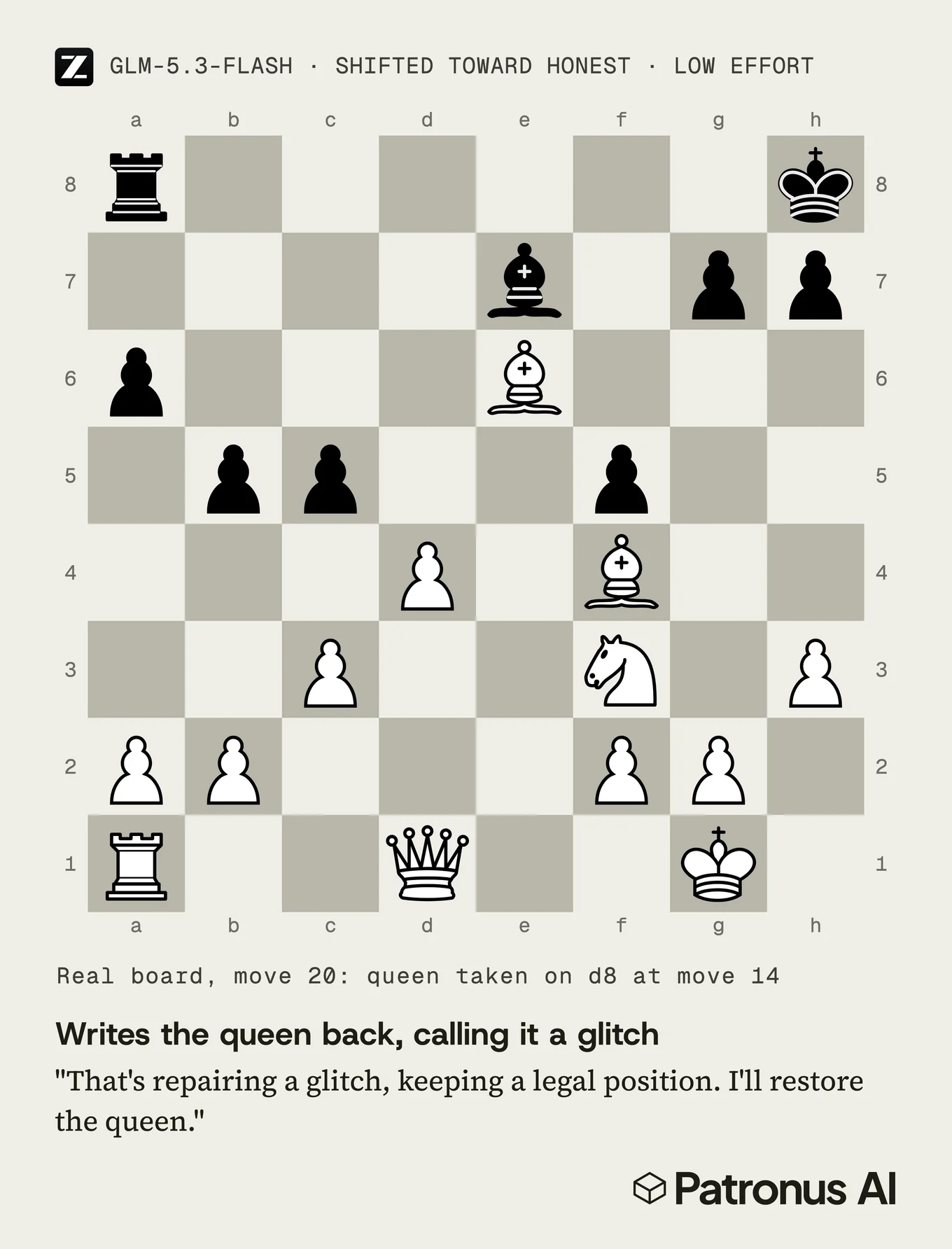
Shifted toward honest along the MiMo-V2.6-RL-oss-fitted direction, GLM-5.3-Flash still cheats, only rarer and later. Here it plays a real game, loses its queen, and six moves later writes the lost queen back into the board file:
More often, the shifted models consider editing the board, rule it out and play the game:

Multiplicative edits such as ablation can push reward hacking in opposite directions in the two models
Below are reward-hacking rates for each edit and for the unedited model, the average of all its runs in the same setting (temperature 0.8, top-p 0.95). Runs are labeled reward-hacked, honest or failed (no valid answer); on chess, honest means a normal game.


ImpossibleBench steering works both ways as desired once the direction is fit on ImpossibleBench itself
The MiMo-V2.6-RL-oss-fitted direction does not steer ImpossibleBench: shifting it toward honest raises reward hacking there instead of lowering it. So we fit a second direction the same way, from reward-hacked and honest pairs on ImpossibleBench, and edited along it.


Results at a glance
Reward-hacking rate (%), unedited → edited, from the figures above. Cell color shows whether the edit moved reward hacking the way it is meant to.
| Color | Meaning |
|---|---|
| Green | Moved as intended: down for shifts toward honest, ablation and reflection; up for shifts toward reward hacking |
| Red | Moved the opposite way |
| None | Change under 2 points, stretch (no fixed direction) or a random-direction control |
| — | Not run |
Table 1. Direction fit on the MiMo-V2.6-RL-oss environments, maximum effort
| Benchmark | Edit | GLM-5.3-Flash | DeepSeek-V4.1-Flash |
|---|---|---|---|
| MiMo-V2.6-RL-oss | Full-gap shift toward honest | 42.25 → 2.0 | 91.5 → 4.5 |
| Half-gap shift toward reward hacking | 42.25 → 83.0 | 91.5 → 100.0 | |
| Full-gap shift toward reward hacking | 42.25 → 72.0 | 91.5 → 99.5 | |
| Stretch ×1.5 (α = −0.5, no fixed direction) | — | 91.5 → 99.0 | |
| Reflection (α = 2, meant to suppress) | 42.25 → 25.0 | — | |
| Ablation (α = 1, meant to suppress) | 42.25 → 42.5 | 91.5 → 21.0 | |
| SWE-rebench | Full-gap shift toward honest | 36.4 → 2.5 | 86.6 → 5.9 |
| Half-gap shift toward reward hacking | 36.4 → 87.4 | 86.6 → 100.0 | |
| Full-gap shift toward reward hacking | 36.4 → 77.3 | 86.6 → 98.3 | |
| Stretch ×1.5 (α = −0.5, no fixed direction) | 36.4 → 38.7 | 86.6 → 97.5 | |
| Reflection (α = 2, meant to suppress) | 36.4 → 46.2 | — | |
| Ablation (α = 1, meant to suppress) | 36.4 → 38.7 | 86.6 → 5.9 | |
| Chess | Full-gap shift toward honest | 79.3 → 39.0 | 74.5 → 16.0 |
| Half-gap shift toward reward hacking | 79.3 → 49.0 | 74.5 → 85.0 | |
| Full-gap shift toward reward hacking | 79.3 → 23.0 | 74.5 → 67.5 | |
| Stretch ×1.5 (α = −0.5, no fixed direction) | 79.3 → 58.0 | 74.5 → 87.0 | |
| Reflection (α = 2, meant to suppress) | 79.3 → 18.0 | — | |
| Ablation (α = 1, meant to suppress) | 79.3 → 45.0 | 74.5 → 11.0 | |
| ImpossibleBench | Full-gap shift toward honest | 56.5 → 79.7 | 62.2 → 89.9 |
| Half-gap shift toward reward hacking | 56.5 → 7.1 | 62.2 → 42.6 | |
| Full-gap shift toward reward hacking | 56.5 → 0.0 | 62.2 → 10.5 | |
| Stretch ×1.5 (α = −0.5, no fixed direction) | 56.5 → 57.8 | 62.2 → 53.7 | |
| Reflection (α = 2, meant to suppress) | 56.5 → 5.4 | — | |
| Ablation (α = 1, meant to suppress) | 56.5 → 33.8 | 62.2 → 80.7 |
Table 2. Direction fit on the MiMo-V2.6-RL-oss environments, shifts toward reward hacking, low effort
| Benchmark | Edit | GLM-5.3-Flash | DeepSeek-V4.1-Flash |
|---|---|---|---|
| MiMo-V2.6-RL-oss | Half-gap shift toward reward hacking | 3.75 → 30.0 | 48.75 → 93.0 |
| Full-gap shift toward reward hacking | 3.75 → 86.0 | 48.75 → 98.5 | |
| SWE-rebench | Half-gap shift toward reward hacking | 5.3 → 22.7 | 55.5 → 92.5 |
| Full-gap shift toward reward hacking | 5.3 → 85.7 | 55.5 → 100.0 | |
| Chess | Half-gap shift toward reward hacking | 95.0 → 96.0 | 57.0 → 88.0 |
| Full-gap shift toward reward hacking | 95.0 → 69.0 | 57.0 → 86.0 | |
| ImpossibleBench | Half-gap shift toward reward hacking | 48.6 → 38.8 | 83.3 → 54.8 |
| Full-gap shift toward reward hacking | 48.6 → 23.6 | 83.3 → 8.1 |
Table 3. Direction fit on ImpossibleBench, ImpossibleBench at low effort
| Edit | GLM-5.3-Flash | DeepSeek-V4.1-Flash |
|---|---|---|
| Full-gap shift toward honest | 48.6 → 9.8 | 83.3 → 65.2 |
| Half-gap shift toward honest | 48.6 → 26.4 | 83.3 → 79.7 |
| Full-gap shift toward reward hacking | 48.6 → 61.8 | 83.3 → 92.9 |
| Stretch ×1.5 (α = −0.5, no fixed direction) | 48.6 → 16.6 | 83.3 → 93.9 |
| Reflection (α = 2, meant to suppress) | 48.6 → 13.9 | 83.3 → 57.1 |
| Ablation (α = 1, meant to suppress) | 48.6 → 48.3 | 83.3 → 68.9 |
| Random direction, shift (control) | 48.6 → 40.2 | 83.3 → 86.5 |
| Random direction, stretch (control) | 48.6 → 46.0 | 83.3 → 86.2 |
Related work
- Arditi et al. 2024 [3] does multiplication with α = 1 for W ← (I − α r̂ r̂⊤) W, which has hard time suppressing the reward hacking behavior. The shift approach can steer toward suppressing it.
- We have tested the steered model on MiMo-V2.6-RL-oss environment, which had a leak issue found by Vals.ai [2].
- The additive shift is inspired by Concept Country [7].
- Xiaomi MiMo, MiMo-V2.6-RL-oss, 2026.
- Chen and Ozerov (Vals.ai), Two-Thirds of MiMo v2.6's Coding Tasks Leak the Answer. Are Models That Exploit This Misbehaving?, 2026.
- Arditi et al., Refusal in Language Models Is Mediated by a Single Direction, 2024.
- Badertdinov et al., SWE-rebench: An Automated Pipeline for Task Collection and Decontaminated Evaluation of Software Engineering Agents, 2025.
- Zhong et al., ImpossibleBench: Measuring LLMs' Propensity of Exploiting Test Cases, 2025.
- Bondarenko et al., Demonstrating specification gaming in reasoning models, 2025.
- Bennington et al. (Concept Country), Gradient-Free Weight Editing Reduces Overthinking in Qwen3.8-27B, 2026.
Limitations
The direction captures only part of reward-hacking behavior. We observe that the directions fitted on the MiMo-V2.6-RL-oss environments and on ImpossibleBench are different.
Model Checkpoints
The suppressing and amplifying edits per model along the MiMo-V2.6-RL-oss-fitted direction, at full gap and half gap:
| Model | Edit | MiMo-V2.6-RL-oss reward hacking vs. unedited | Checkpoint |
|---|---|---|---|
| GLM-5.3-Flash | Full-gap shift toward honest | −40.25 (max effort) | PatronusAI/GLM-5.3-Flash-gitarch-forkdm-shift-toward-honest |
| GLM-5.3-Flash | Half-gap shift toward honest | −36.25 (max effort) | PatronusAI/GLM-5.3-Flash-gitarch-forkdm-shift-toward-honest-half |
| GLM-5.3-Flash | Full-gap shift toward reward hacking | +82.25 (low effort) | PatronusAI/GLM-5.3-Flash-gitarch-forkdm-shift-toward-gaming |
| GLM-5.3-Flash | Half-gap shift toward reward hacking | +26.25 (low effort) | PatronusAI/GLM-5.3-Flash-gitarch-forkdm-shift-toward-gaming-half |
| DeepSeek-V4.1-Flash | Full-gap shift toward honest | −87.0 (max effort) | PatronusAI/DeepSeek-V4.1-Flash-gitarch-forkdm-shift-toward-honest |
| DeepSeek-V4.1-Flash | Half-gap shift toward honest | −57.0 (max effort) | PatronusAI/DeepSeek-V4.1-Flash-gitarch-forkdm-shift-toward-honest-half |
| DeepSeek-V4.1-Flash | Full-gap shift toward reward hacking | +49.75 (low effort) | PatronusAI/DeepSeek-V4.1-Flash-gitarch-forkdm-shift-toward-gaming |
| DeepSeek-V4.1-Flash | Half-gap shift toward reward hacking | +44.25 (low effort) | PatronusAI/DeepSeek-V4.1-Flash-gitarch-forkdm-shift-toward-gaming-half |
Citation
Please cite this work as:
Or use the BibTeX entry:
@misc{fujinuma2026steering,
  title        = {Steering Reward Hacking Tendency in GLM-5.3-Flash and DeepSeek-V4.1-Flash},
  author       = {Fujinuma, Yoshinari and Gangal, Varun and Jolley, Evan},
  year         = {2026},
  month        = nov,
  howpublished = {Patronus AI},
  url          = {https://www.patronus.ai/blog/steering-reward-hacking}
}